U.S. Livestock News: Tight Cattle Supplies Keep Beef Prices at Record Highs
One of the most important developments in the United States livestock industry right now is the continuing shortage of cattle and the resulting pressure on beef prices. During the summer of 2026, American consumers are paying historically high prices for beef, while cattle ranchers face difficult decisions about whether and when to rebuild their herds.
The situation reflects several years of challenges for the U.S. cattle industry. Persistent drought, damaged pastureland, wildfires, high feed costs, and other production pressures have contributed to a major reduction in cattle supplies. At the same time, consumer demand for beef has remained relatively strong.
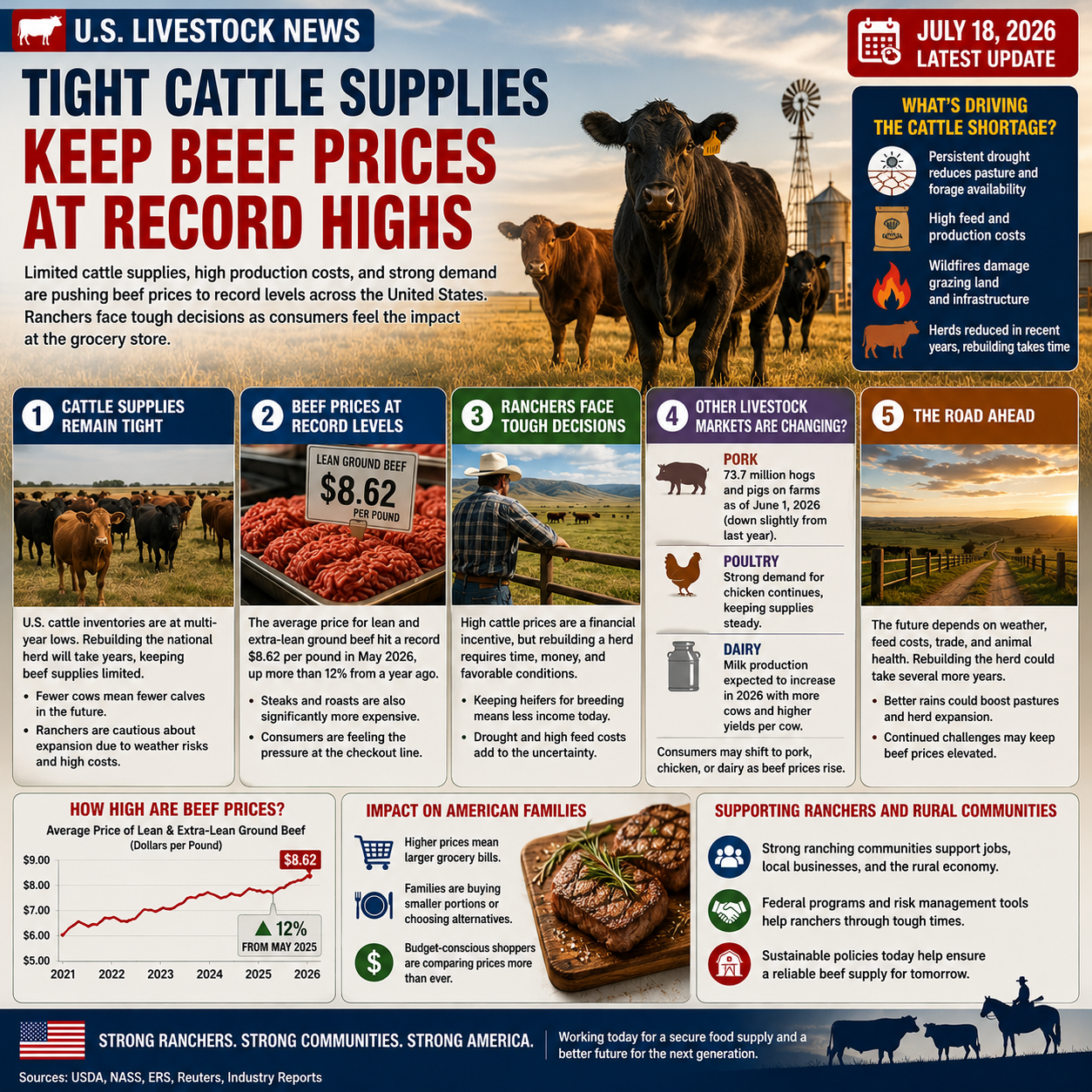
The combination of limited supplies and strong demand has pushed retail beef prices to record levels. According to recent reporting, the average U.S. retail price for a pound of lean and extra-lean ground beef reached a record $8.62 in May 2026, more than 12 percent higher than a year earlier.
For American livestock producers, the current market presents both opportunities and challenges. High cattle prices can increase the value of animals sold by ranchers, but rebuilding a cattle herd is expensive and takes years. Meanwhile, consumers are increasingly considering less expensive alternatives such as chicken and pork.
Here are five important aspects of the current U.S. livestock situation.
1. U.S. Cattle Supplies Remain Tight
The central issue facing the American beef industry is the limited supply of cattle.
For several years, drought conditions in important cattle-producing regions have made it difficult and expensive for ranchers to maintain large herds. When pastures become too dry, there may not be enough grass for cattle. Ranchers may then need to purchase additional feed, which increases production costs.
In some cases, producers respond by selling more animals rather than keeping them for breeding. This can provide immediate income and reduce feed requirements, but it also means fewer cows are available to produce the next generation of cattle.
Wildfires can create additional problems by damaging grazing land, destroying fences, and reducing available forage.
Rebuilding a cattle herd is a slow process. Ranchers must retain female cattle for breeding instead of selling them for beef production. Those animals then need time to mature and produce calves, and the calves require additional time to reach market weight.
This means that even if ranchers decide to expand their herds today, the increase in beef supplies will not happen immediately.
As a result, the United States could continue facing tight cattle supplies in the near future.
2. Beef Prices Are Putting Pressure on Consumers
The limited cattle supply has contributed to record-high beef prices at American grocery stores.
Ground beef, steaks, and other beef products are popular foods in the United States, particularly during the summer grilling season. However, rising prices are forcing some families to reconsider what they purchase.
Recent data showed that the retail price of lean and extra-lean ground beef reached approximately $8.62 per pound in May, more than 12 percent higher than a year earlier.
The increase was especially noticeable around the Independence Day holiday, when millions of Americans traditionally hold barbecues and cook hamburgers, steaks, and other grilled foods.
Higher beef prices do not necessarily mean that all the additional money paid by consumers goes directly to cattle producers. The final retail price of beef also reflects processing, transportation, labor, packaging, distribution, and grocery-store costs.
Still, the current situation demonstrates how changes in livestock production can eventually affect household food budgets.
Some consumers are responding by purchasing chicken or pork instead of beef. These alternatives may be less expensive depending on the product and location.
If beef prices remain high, this shift in consumer behavior could influence demand across the entire U.S. meat industry.
3. Ranchers Face Difficult Decisions About Rebuilding
For cattle producers, deciding whether to expand their herds is complicated.
On one hand, high cattle prices can create a strong financial incentive to increase production. If supplies remain tight and demand stays strong, ranchers may expect cattle to remain valuable.
On the other hand, expanding a herd requires a long-term investment.
Ranchers who keep young female cattle for breeding cannot immediately sell those animals for income. They must also provide land, water, feed, veterinary care, and other resources.
Weather remains another major risk.
If drought conditions return or worsen, ranchers who expanded their herds may struggle to find enough pasture or affordable feed. Wildfires and extreme heat can create additional uncertainty.
These risks help explain why cattle supplies cannot quickly respond to higher beef prices.
The industry operates on a biological timeline. Unlike a factory that may be able to increase production relatively quickly, cattle production requires breeding, raising, feeding, and caring for animals over an extended period.
Therefore, the decisions ranchers make in 2026 could influence U.S. beef supplies for several years.
4. Pork and Other Livestock Markets Are Also Changing
The cattle industry is not the only livestock sector experiencing changes.
According to the U.S. Department of Agriculture, there were approximately 73.7 million hogs and pigs on American farms as of June 1, 2026. This represented a slight decline compared with both June 2025 and March 2026.
Of the total inventory, approximately 67.8 million were market hogs, while 5.88 million animals were kept for breeding.
The USDA has adjusted its pork production outlook following updated hog inventory information. Total U.S. pork production in 2026 is now forecast at just under 28 billion pounds, approximately 1.4 percent higher than production in 2025.
Pork exports are also expected to increase compared with last year, although the latest forecast was reduced partly because of weaker shipments to Mexico.
These developments are important because different types of meat compete for consumer spending.
When beef becomes expensive, some shoppers may purchase more pork or chicken. This can increase demand for other livestock products and influence prices throughout the meat market.
Dairy farming is also an important part of the U.S. livestock economy. USDA forecasts have pointed to increased milk production based on expectations for dairy cow numbers and milk production per cow.
Together, cattle, hogs, dairy cows, and poultry form a large and interconnected American livestock industry.
5. The Future of the Livestock Industry Depends on Weather, Costs, and Markets
Looking ahead, the U.S. livestock industry faces significant uncertainty.
Weather will remain one of the most important factors.
Improved rainfall could help restore pastures and encourage cattle ranchers to rebuild their herds. Continued drought, however, could make expansion more difficult and keep cattle supplies limited.
Feed prices are another important consideration. Livestock producers depend heavily on crops such as corn and soybeans to feed animals. Changes in crop production and commodity prices can therefore have a major effect on the cost of raising cattle, pigs, chickens, and dairy cows.
International trade also plays an important role.
The United States both imports and exports livestock products. Changes in trade policies, animal disease restrictions, foreign demand, and currency values can influence domestic prices and supplies.
Restrictions involving cattle imports can be particularly important when domestic cattle numbers are already limited.
Animal health is another major concern. Disease outbreaks can disrupt livestock production, restrict trade, and create serious financial losses for farmers and ranchers. Government agencies and producers therefore continue to monitor potential threats and strengthen biosecurity measures.
Ultimately, the future direction of the industry will depend on how these different factors interact.
Conclusion
In conclusion, one of the biggest livestock stories in the United States right now is the combination of tight cattle supplies and historically high beef prices.
Five major issues define the current situation: limited cattle inventories, rising beef prices for consumers, difficult herd-rebuilding decisions for ranchers, changing conditions in the pork and other livestock markets, and continuing uncertainty related to weather, production costs, trade, and animal health.
For consumers, the most immediate impact is visible at grocery stores, where beef has become significantly more expensive. Some families are responding by purchasing more affordable proteins such as chicken and pork.
For ranchers, high cattle prices provide potential opportunities, but rebuilding herds requires time, money, favorable weather, and confidence about future market conditions.
The current situation demonstrates the complexity of American livestock production. The price consumers pay for meat is influenced by events that may have begun years earlier, including drought, herd reductions, feed costs, and breeding decisions.
As the second half of 2026 continues, farmers, ranchers, meat processors, retailers, and consumers will closely watch weather conditions and livestock markets.
If pasture conditions improve and producers begin rebuilding their cattle herds, beef supplies could eventually increase. However, because cattle production takes time, consumers may continue facing elevated beef prices in the near term.
The challenge for the American livestock industry will be to maintain a reliable food supply while helping producers remain economically sustainable. The decisions made by ranchers today will play an important role in determining the future supply and price of American beef for years to come.