The Benefits of Animal Farming: Five Major Advantages
Animal farming has played an important role in human civilization for thousands of years. From small family farms to large agricultural businesses, raising animals provides food, income, employment, and many other valuable resources for people around the world. Farmers raise different kinds of animals, including cattle, pigs, chickens, ducks, goats, sheep, and other livestock, depending on local conditions and market demand. Animal farming not only supports individual families but also contributes significantly to communities and national economies.
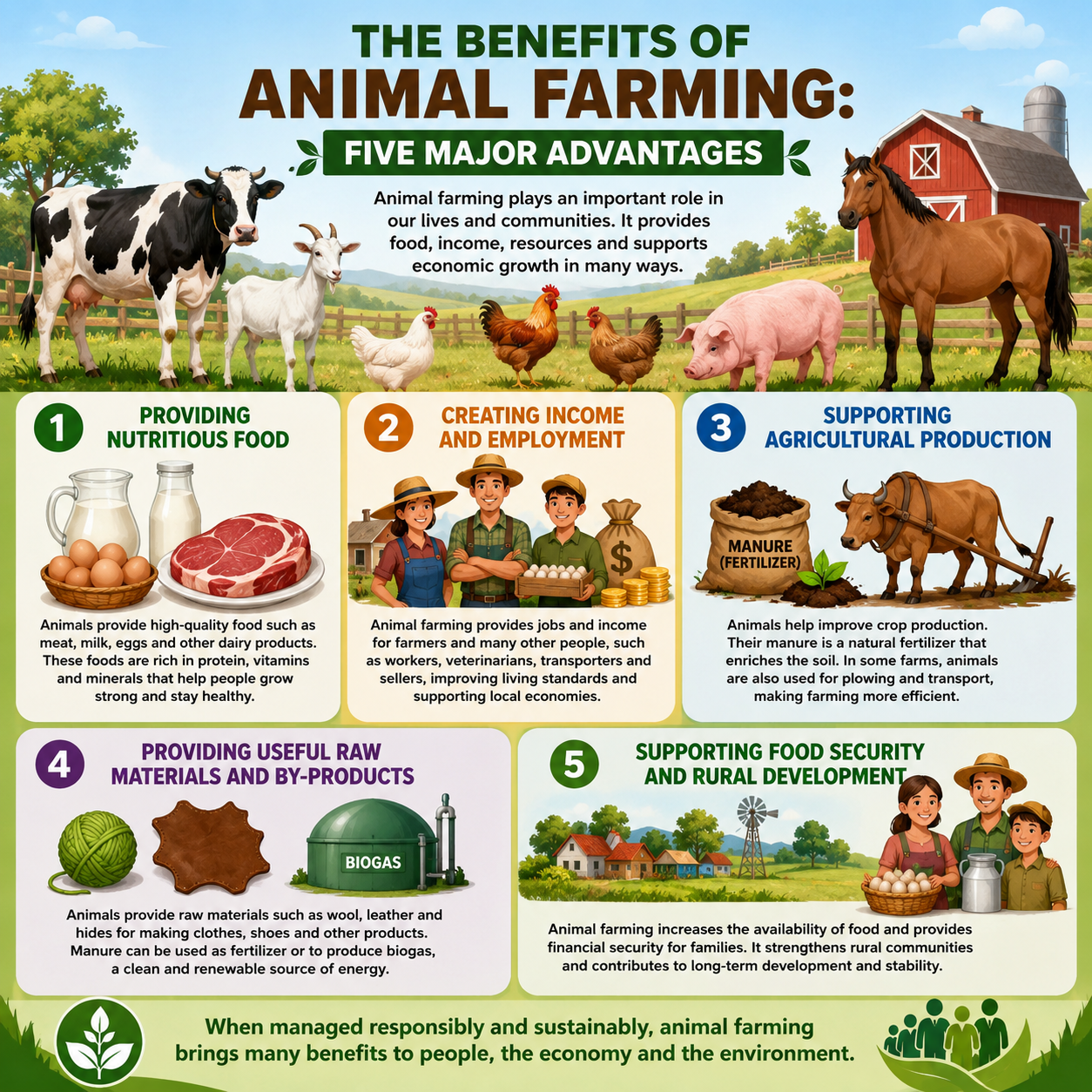
In many developing countries, livestock farming is an essential part of rural life. Families often depend on animals as a source of food and income, while larger farms help supply animal products to growing populations. When managed responsibly and sustainably, animal farming can provide many benefits to society. Five of the most important advantages are providing nutritious food, creating income and employment, supporting agricultural production, supplying useful raw materials, and contributing to food security and rural development.
1. Providing Nutritious Food
One of the most important benefits of animal farming is the production of nutritious food. Farm animals provide a variety of foods, including meat, milk, eggs, and dairy products. These foods are widely consumed around the world and can be important components of a balanced diet.
Animal-based foods contain essential nutrients that the human body needs for growth, development, and good health. Meat, eggs, and milk are rich sources of high-quality protein. Protein is important for building and repairing muscles and body tissues. Animal products can also provide important vitamins and minerals, such as vitamin B12, iron, zinc, and calcium.
Milk and dairy products, for example, are well known for providing calcium, which helps support healthy bones and teeth. Eggs are a versatile and nutritious food containing protein and various vitamins and minerals. Meat can provide protein, iron, and other essential nutrients.
Animal farming therefore contributes to the availability of nutritious foods for individuals and families. However, a healthy diet should be balanced and can also include vegetables, fruits, grains, legumes, nuts, and other plant-based foods. By producing a variety of animal products, livestock farming helps expand the food choices available to consumers.
2. Creating Income and Employment Opportunities
Another major advantage of animal farming is its ability to generate income and create employment. Millions of people around the world depend directly or indirectly on livestock farming for their livelihoods.
Farmers can earn money by selling animals and animal products such as meat, milk, eggs, and wool. For small-scale farmers, raising chickens, ducks, pigs, cattle, or goats can provide an important source of household income. The money earned from animal farming can help families pay for food, education, healthcare, housing, and other daily needs.
Animal farming also creates jobs beyond the farm itself. Workers may be needed to care for animals, produce and distribute animal feed, provide veterinary services, transport livestock, process meat and dairy products, package food, and sell products in markets and stores. This creates a network of economic activities connected to livestock production.
In rural communities where other employment opportunities may be limited, animal farming can be particularly valuable. It can provide people with opportunities to start small businesses and gradually improve their economic conditions. With proper training, access to markets, and responsible management, livestock farming can become a sustainable source of income for many families.
3. Supporting Agricultural Production
Animal farming and crop farming can support each other in an integrated agricultural system. Farm animals can contribute to crop production in several ways, making them valuable to farmers who combine livestock and crop farming.
One important contribution is animal manure, which can be used as an organic fertilizer. Manure contains nutrients that can improve soil fertility and support plant growth when it is properly treated and applied. Using animal manure can help farmers recycle nutrients within the farm and, in some situations, reduce dependence on synthetic fertilizers.
In some farming communities, animals such as cattle and buffalo are also used for agricultural work. They can help farmers plow fields, pull carts, and transport agricultural products. Although modern machinery has replaced animal labor in many areas, working animals remain useful in some rural communities where tractors and other equipment may be expensive or difficult to access.
Integrated farming can also make efficient use of agricultural resources. Certain crop residues and by-products that are unsuitable for direct human consumption may be used as animal feed when appropriate and safe. In return, manure from the animals can help fertilize crops. This creates a productive cycle between crop and livestock farming.
Therefore, animal farming can be an important part of a broader agricultural system, helping farmers make better use of available resources and improve overall farm productivity.
4. Providing Useful Raw Materials and By-products
Animal farming provides more than just food. Livestock can also supply valuable raw materials that are used to produce a wide range of goods.
For example, sheep provide wool, which is used to make clothing, blankets, carpets, and other textile products. Leather derived from animal hides is used in products such as shoes, bags, belts, furniture, and other goods. Animal farming therefore supports industries that manufacture and sell these products.
Other animal by-products can also have practical uses when they are processed safely and responsibly. Manure, for instance, can be used as organic fertilizer and can sometimes be processed to produce biogas, a renewable source of energy. Biogas systems can convert organic waste into fuel that may be used for cooking, heating, or electricity generation.
The use of animal by-products can help reduce waste and increase the economic value generated from livestock farming. Instead of allowing useful materials to go unused, farmers and industries can process them into valuable products.
These activities also create additional business and employment opportunities. Industries related to leather, wool, fertilizer, food processing, and renewable energy can all benefit from resources generated through animal farming.
5. Supporting Food Security and Rural Development
Finally, animal farming can contribute to food security and the development of rural communities. Food security means that people have reliable access to sufficient, safe, and nutritious food.
By producing meat, milk, eggs, and other foods, livestock farmers contribute to local and national food supplies. Local animal production can be especially important in communities where transportation and food distribution systems are limited.
Livestock can also serve as an economic asset for farming households. Farmers may sell animals or animal products when they need additional income. This can provide families with greater financial flexibility, although successful livestock farming also requires careful planning because farmers face risks such as animal diseases, changing market prices, and extreme weather.
At the community level, a productive livestock sector can encourage rural economic development. As farms grow, demand may increase for veterinary care, feed suppliers, transportation, processing facilities, markets, and other supporting services. These activities can create jobs and strengthen local economies.
For animal farming to remain beneficial in the long term, however, sustainable practices are essential. Farmers should protect animal health and welfare, manage manure responsibly, use water and land efficiently, prevent the spread of disease, and minimize negative environmental impacts. Sustainable livestock management can help balance economic and food-production benefits with environmental protection.
Conclusion
In conclusion, animal farming provides many important benefits to individuals, families, communities, and economies. The five major advantages are providing nutritious food, creating income and employment opportunities, supporting agricultural production, supplying useful raw materials and by-products, and strengthening food security and rural development.
Livestock farming remains an important part of agriculture in many countries, particularly in rural areas where people depend on animals for both food and livelihoods. It can support farmers, generate employment, provide valuable products, and contribute to broader economic development.
However, the future of animal farming depends on responsible and sustainable management. Farmers, governments, businesses, and communities should work together to promote good animal welfare, effective disease prevention, responsible resource use, and environmental protection. By adopting sustainable farming practices, society can continue to benefit from animal farming while reducing its potential negative impacts and preserving natural resources for future generations.