Wildfire Smoke Creates Unhealthy Air Across Large Parts of the United States
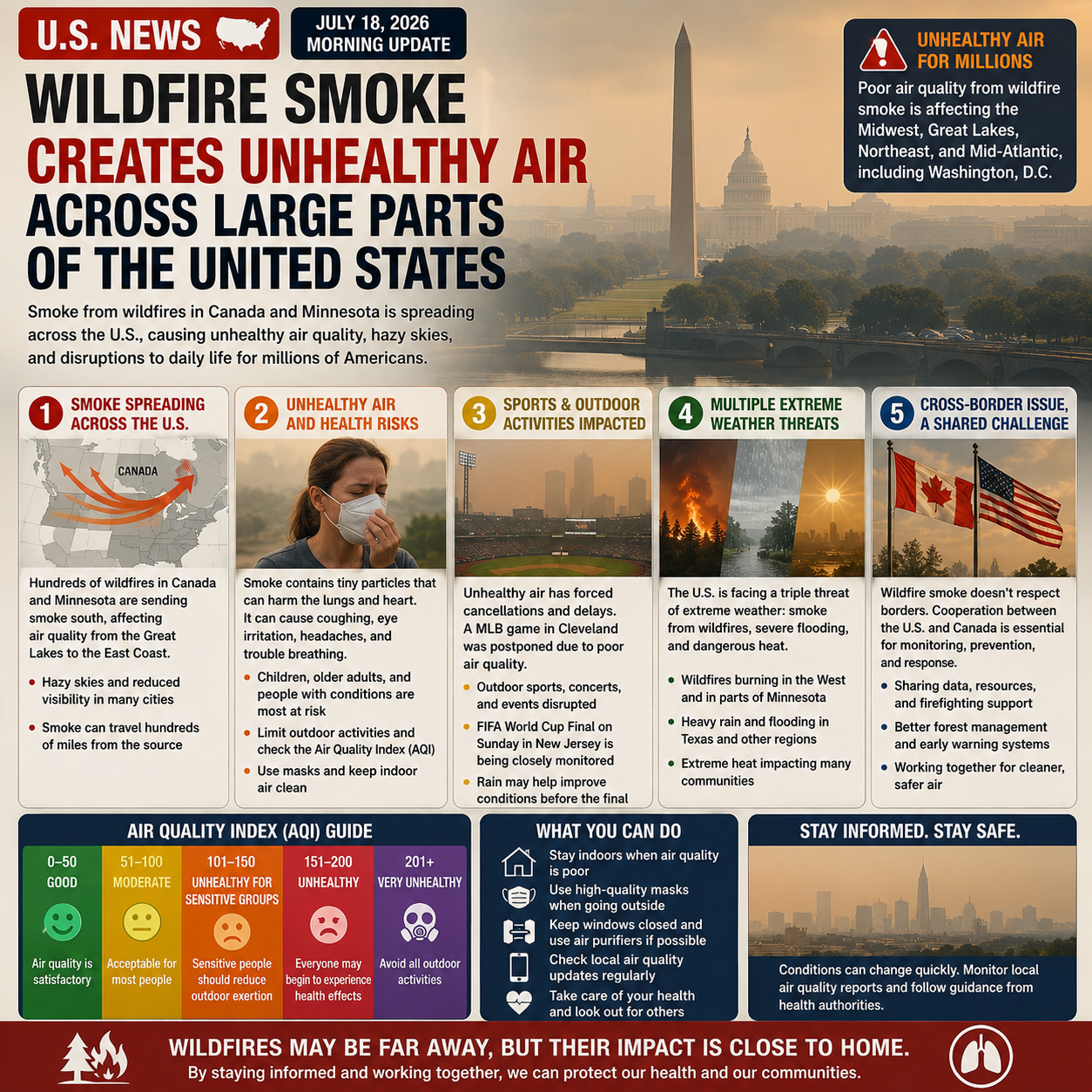
One of the most important events affecting the United States this morning is the widespread wildfire smoke that continues to create unhealthy air conditions across large parts of the country. Smoke from hundreds of wildfires burning in Canada, together with fires in Minnesota, has traveled across the border and spread through portions of the Midwest, Great Lakes, Northeast, and Mid-Atlantic regions.
The situation has affected millions of Americans, creating hazy skies, reducing visibility, disrupting outdoor activities, and raising serious concerns about public health. Cities including Washington, D.C., Chicago, Detroit, Pittsburgh, and other communities have experienced poor air quality as smoke particles remain in the atmosphere.
Although the wildfires themselves may be hundreds or even thousands of miles away from many affected communities, wind patterns can carry smoke over enormous distances. This demonstrates how a major environmental disaster in one region can quickly become a public-health problem across a much larger geographical area.
The smoke crisis is particularly significant because it comes during a summer in which different parts of the United States are simultaneously dealing with wildfires, flooding, extreme heat, and other severe weather conditions.
Here are five important aspects of this major developing story.
1. Wildfire Smoke Is Affecting Millions of Americans
The most immediate problem is the enormous geographical reach of the wildfire smoke.
Smoke from Canadian wildfires has moved south into the United States, while fires burning in Minnesota have also contributed to poor air conditions in some regions.
Large areas from the Great Lakes to the East Coast have experienced hazy skies and elevated levels of air pollution.
Washington, D.C., has been among the affected locations, with smoke creating visible haze around the nation’s capital. Other major cities have also experienced unhealthy conditions.
The ability of wildfire smoke to travel such long distances means that people do not need to live near an active fire to experience its consequences.
Atmospheric conditions play an important role in determining where smoke travels. Winds can transport smoke across states and national borders, while high-pressure weather systems can sometimes trap polluted air closer to the ground.
When this happens, smoke can remain over populated areas for extended periods.
The situation has become a reminder that wildfires are no longer only a problem for rural or forest communities. Major cities far from the flames can also experience serious impacts.
2. Unhealthy Air Creates Public-Health Concerns
One of the biggest concerns associated with wildfire smoke is its impact on human health.
Wildfire smoke contains very small particles that can travel deep into the lungs. Exposure can cause coughing, eye irritation, throat discomfort, headaches, and difficulty breathing.
Certain groups may face greater risks, including children, older adults, pregnant people, outdoor workers, and individuals with existing heart or respiratory conditions.
When air quality reaches unhealthy levels, health officials generally recommend that people reduce prolonged or strenuous outdoor activities. In areas experiencing particularly poor conditions, residents may be encouraged to spend more time indoors.
People who must go outside may also consider using well-fitting, high-quality masks that can help filter fine particles.
The current smoke event demonstrates why air-quality monitoring has become increasingly important.
Many Americans now regularly check the Air Quality Index, or AQI, alongside traditional weather forecasts. The AQI provides information about pollution levels and helps people decide whether outdoor activities may pose health risks.
During major wildfire smoke events, air quality can change rapidly depending on wind direction and weather conditions.
For this reason, residents in affected areas should continue monitoring information from local authorities and official air-quality services.
3. Sports and Outdoor Activities Have Been Disrupted
The wildfire smoke has also caused disruptions to sports and other outdoor activities.
When air pollution reaches dangerous levels, athletes, workers, and spectators can face health risks from prolonged exposure.
Some professional sporting events have already been affected by poor air quality.
A Major League Baseball game between the Pittsburgh Pirates and Cleveland Guardians was postponed after air conditions in Cleveland reached very unhealthy levels. Other sporting events have also faced schedule changes or concerns because of smoke.
These disruptions demonstrate the wider social and economic impact of wildfire pollution.
Outdoor concerts, festivals, youth sports, construction work, tourism activities, and community events may all be affected when air quality becomes dangerous.
The situation has also attracted attention because the United States is hosting the final stages of the 2026 FIFA World Cup.
The championship match between Spain and Argentina is scheduled to take place on Sunday at the New York New Jersey Stadium in East Rutherford, New Jersey.
Weather forecasters have indicated that conditions could improve before the final, with rain potentially helping to reduce some of the smoke. However, air quality remains an issue that organizers, players, and spectators are monitoring closely.
The situation highlights how environmental conditions can influence even the world’s largest sporting events.
4. The United States Is Facing Multiple Extreme Weather Threats
The wildfire smoke is only one of several major environmental challenges affecting the United States this summer.
Different regions of the country are dealing with very different types of extreme conditions.
While the Midwest and East Coast have experienced smoke from wildfires, parts of Texas have faced severe flooding following intense rainfall.
At the same time, wildfires are burning in parts of the western United States, where dry conditions and low snowpack have increased fire risks.
This combination of smoke, fires, flooding, and extreme heat has placed significant pressure on emergency services and local communities.
Scientists have long warned that a warming climate can increase the likelihood or severity of certain types of extreme weather.
Higher temperatures can dry vegetation and create conditions that allow wildfires to spread more easily. A warmer atmosphere can also hold more moisture, potentially contributing to heavier rainfall during certain storms.
However, individual weather disasters are influenced by many different factors, including local geography and specific atmospheric conditions.
The simultaneous occurrence of multiple extreme events demonstrates the growing challenge of preparing communities for environmental emergencies.
Emergency planning increasingly requires governments to prepare for several different types of disasters at the same time.
5. Cross-Border Cooperation Is Becoming Increasingly Important
The current smoke crisis also demonstrates the environmental connection between the United States and Canada.
Wildfire smoke does not recognize national borders.
A fire burning in Canada can affect air quality in American cities hundreds of miles away. Similarly, environmental events originating in the United States can have consequences for neighboring countries.
The cross-border nature of the current crisis has also created political tensions.
President Donald Trump has criticized Canada’s management of its forests and suggested that the economic cost of wildfire smoke affecting the United States should be considered in broader discussions about trade and tariffs.
Canadian officials, however, have defended their country’s efforts to manage forests and respond to increasingly difficult wildfire seasons.
Regardless of political disagreements, cooperation between the two countries remains important.
Firefighters, emergency agencies, scientists, weather forecasters, and environmental authorities can share information and resources to better understand and respond to large wildfire events.
The United States and Canada have deeply connected ecosystems and weather systems. As a result, environmental emergencies in one country can quickly affect the other.
Long-term solutions may require improved wildfire prevention, stronger emergency response systems, better air-quality monitoring, and continued scientific research.
Conclusion
In conclusion, one of the most important events affecting the United States this morning is the widespread wildfire smoke creating unhealthy air conditions across large parts of the country.
Five major issues define the current situation: the enormous geographical spread of wildfire smoke, growing public-health concerns, disruptions to sports and outdoor activities, multiple extreme weather threats affecting different parts of the country, and the increasing importance of cooperation between the United States and Canada.
For millions of Americans, the most immediate concern is air quality.
Even communities located far from active wildfires can experience dangerous pollution when winds carry smoke across long distances. This means that residents should pay attention to local air-quality information and follow guidance from health and emergency authorities.
The situation also demonstrates how environmental disasters can have consequences far beyond the location where they begin.
Wildfires in remote forests can affect major American cities, disrupt professional sports, influence international events, and create political tensions between neighboring countries.
As the summer continues, weather conditions will determine how quickly the smoke clears and whether additional wildfire activity creates new problems.
In the longer term, the current crisis is another reminder of the importance of wildfire preparedness, emergency planning, environmental cooperation, and public-health protection.
The challenge facing the United States is not simply fighting fires when they begin. It is also preparing communities hundreds of miles away for the smoke and pollution that those fires can produce.
As wildfire seasons become an increasingly important concern across North America, governments and communities will need to strengthen their ability to respond to both the flames and the far-reaching consequences of the smoke.