New Federal Policies Aim to Boost Domestic Seafood Production
One of the most important developments in the United States fishing industry right now is a major federal effort to increase domestic seafood production and create more opportunities for American commercial fishermen. In July 2026, the National Oceanic and Atmospheric Administration, or NOAA, announced a series of regional priorities aimed at reducing regulatory burdens, improving access to fishing grounds, increasing seafood production, and strengthening the economic position of the U.S. fishing industry.
The initiative comes as the federal government seeks to make the United States more competitive in the global seafood market. American commercial and recreational fisheries support coastal communities, provide jobs, supply seafood to consumers, and contribute significantly to the national economy. However, the industry also operates under regulations designed to prevent overfishing, protect marine habitats, and ensure that fish populations remain productive for future generations.
The current policy changes have therefore created an important national discussion about how the United States can increase domestic seafood production while continuing to protect marine ecosystems and maintain sustainable fish populations.
Here are five important aspects of the current U.S. fishing situation.
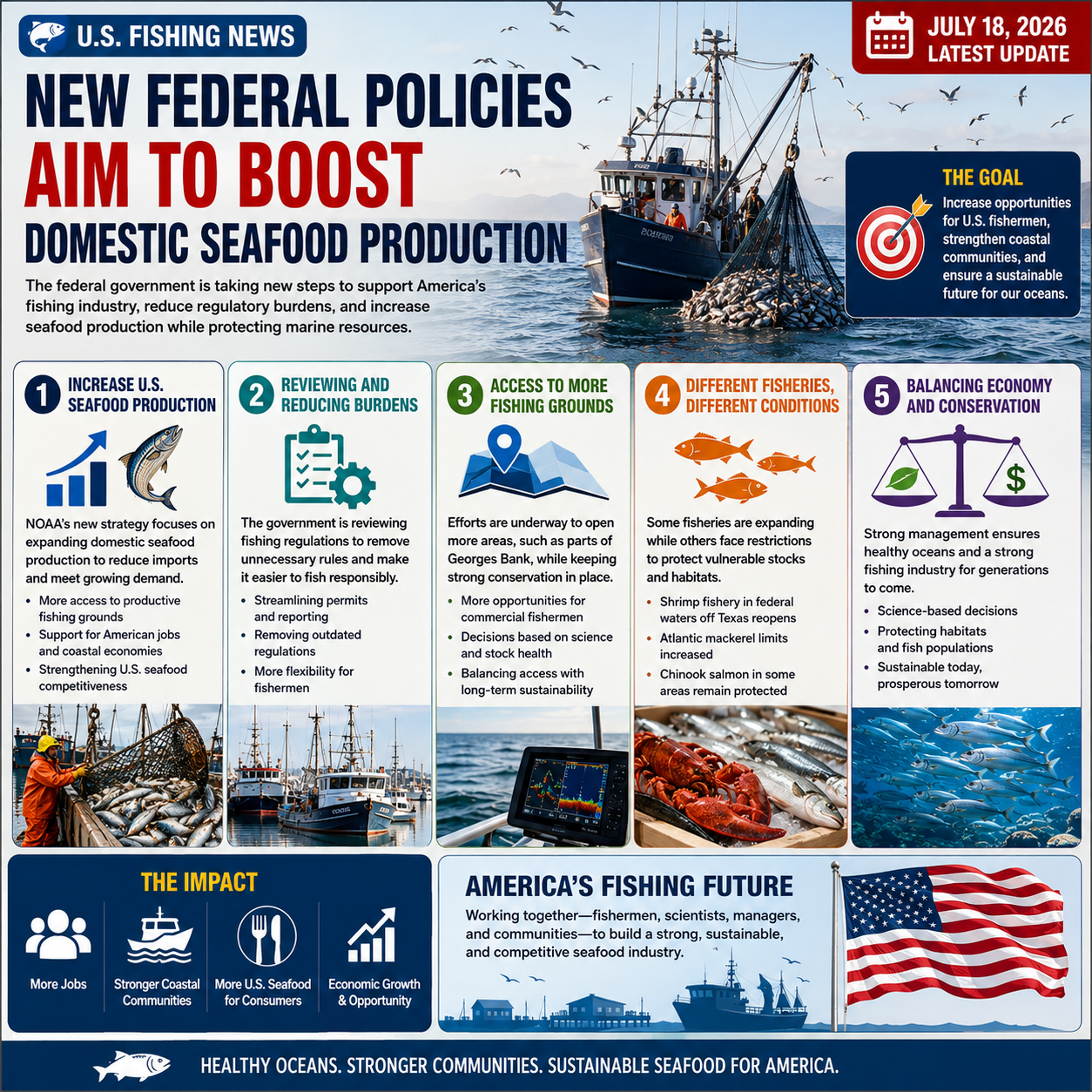
1. The Federal Government Wants to Increase U.S. Seafood Production
A major focus of the new federal strategy is increasing the amount of seafood caught and produced within the United States.
On July 2, NOAA announced regional priorities designed to support the administration’s goal of restoring American seafood competitiveness. The agency said its efforts would focus on reducing burdens on domestic fishing, increasing production, improving fishing opportunities, and strengthening economic profitability.
The United States has extensive marine resources along the Atlantic, Pacific, Gulf, and Alaskan coasts. American fishermen harvest a wide variety of seafood, including salmon, pollock, cod, crab, shrimp, scallops, tuna, and many other species.
Despite these resources, the United States continues to import significant quantities of seafood from other countries.
Supporters of the new strategy argue that increasing domestic production could help American fishermen compete more effectively, strengthen coastal economies, create jobs, and provide consumers with more U.S.-caught seafood.
The federal government has directed NOAA Fisheries to work with regional fishery management councils and industry representatives to identify regulations and management policies that may be limiting fishing opportunities.
However, increasing production is not simply a matter of allowing fishermen to catch more fish. Managers must also consider the health of fish populations and the long-term sustainability of marine resources.
2. Fishing Regulations Are Being Reviewed Across the Country
Another important part of the initiative is a broad review of fishing regulations.
Commercial fishermen in different regions often operate under complex systems of permits, quotas, seasonal closures, catch limits, gear restrictions, and other requirements.
These regulations are generally intended to prevent overfishing and manage competition for limited marine resources. However, some fishermen argue that certain rules are unnecessarily complicated or prevent them from taking advantage of healthy fish populations.
The federal government is now examining ways to reduce some of these regulatory burdens.
Regional priorities cover fisheries throughout Alaska, New England, the Mid-Atlantic, South Atlantic, Gulf, Pacific, Caribbean, and Western Pacific regions.
The exact changes will vary depending on the species and location because fishing conditions are very different across the country.
For example, a management policy appropriate for Alaska’s massive pollock fisheries may not be suitable for scallop fishermen in New England or shrimp fishermen in the Gulf.
NOAA Fisheries has emphasized the importance of working through regional management processes as these priorities move forward.
The challenge will be determining which regulations can be modified to increase economic opportunities without creating unacceptable risks for fish populations or marine ecosystems.
3. New England Fishing Grounds Are Part of the Debate
One of the most closely watched issues involves fishing grounds in New England.
The administration has expressed interest in increasing access to areas where commercial fishing has been restricted. This includes discussions surrounding scallop fishing in parts of Georges Bank.
Georges Bank is a highly productive marine area off the New England coast that has historically supported important American fisheries.
However, sections of the region have faced fishing restrictions because of concerns about overfishing and declining populations of certain species, including Atlantic cod.
Supporters of reopening additional fishing areas argue that improved management and changing conditions could provide new economic opportunities for commercial fishermen.
Conservation concerns remain important, however. Some scientists and fishery managers emphasize that reopening protected areas must be carefully evaluated to ensure that increased fishing does not damage recovering fish populations or important spawning grounds.
The debate illustrates one of the central challenges facing modern fisheries management.
Fishing communities depend on access to marine resources for their livelihoods. At the same time, the long-term future of those communities depends on maintaining healthy and productive fish populations.
If too many fish are harvested, stocks can decline, potentially leading to even more severe restrictions in the future.
Therefore, successful fisheries policy must attempt to balance short-term economic opportunities with long-term conservation.
4. Different Fisheries Face Different Conditions
While federal policy is focused on expanding opportunities, the situation is not the same for every fishery.
Some fish populations can support increased harvest, while others continue to face conservation challenges.
For example, NOAA scientists recently reported new research into declines of Chinook salmon in the Yukon River. Researchers identified increased mortality between juvenile and adult life stages associated with recent heatwaves as an important factor in the decline.
In another example, recreational fishing for Chinook salmon in the federal waters of the Cook Inlet area in Alaska is prohibited from May 1 through August 15, 2026. NOAA Fisheries said the action was necessary for conservation and management because of the low acceptable biological catch and other factors.
Meanwhile, other fisheries are seeing expanded opportunities. The shrimp fishery in federal waters off Texas reopened on July 15 after a seasonal closure.
Atlantic mackerel has also shown signs of improvement, allowing increases in some fishery specifications and possession limits.
These examples demonstrate why fisheries cannot all be managed under a single approach.
Scientists and managers must examine the health of individual fish stocks and ecosystems before deciding how much fishing should be allowed.
When a fish population is healthy, managers may be able to increase catch limits. When a population is struggling, restrictions may be necessary to allow it to recover.
5. The Future Depends on Balancing Economics and Conservation
The biggest long-term question facing the U.S. fishing industry is how to increase economic opportunities while maintaining sustainable fisheries.
Commercial fishing is extremely important to many coastal communities. Fishing vessels support jobs not only for captains and crews but also for seafood processors, restaurants, transportation companies, equipment suppliers, ports, and many other businesses.
According to NOAA, U.S. commercial and recreational fisheries contributed more than 1.7 million jobs and approximately $319 billion in national fishery sales in 2023.
These figures demonstrate the enormous economic importance of marine resources.
However, history has also shown the dangers of overfishing.
When fish populations decline severely, the economic consequences can be devastating for fishing communities. Fishermen may face lower catch limits or complete closures, while seafood processors and other businesses may lose access to important supplies.
Sustainable management therefore plays an important role in protecting both the environment and the long-term economic future of the industry.
Modern fisheries management uses scientific surveys, catch data, population models, and other information to estimate the health of fish stocks. Managers then use this information to establish quotas, seasons, and other rules.
The current federal effort to reduce regulatory burdens will test whether the United States can create more fishing opportunities while maintaining these conservation principles.
Conclusion
In conclusion, one of the most important developments in the United States fishing industry right now is the federal government’s effort to increase domestic seafood production and reduce regulatory burdens on American fishermen.
Five major issues define the current situation: the push to increase U.S. seafood production, the review of fishing regulations across the country, debate over access to fishing grounds such as Georges Bank, different conditions facing individual fisheries, and the challenge of balancing economic growth with marine conservation.
The initiative could create new opportunities for fishermen and coastal communities, particularly if healthy fish populations can support increased harvests.
However, the future of American fishing depends on maintaining sustainable marine resources. Expanding fishing opportunities without adequate scientific management could create long-term problems, while regulations that are unnecessarily restrictive could limit economic opportunities for fishing communities.
The coming months will therefore be important for the U.S. seafood industry. NOAA Fisheries, regional fishery management councils, scientists, commercial fishermen, conservation organizations, and coastal communities will all have a role in determining how the new priorities are implemented.
The central challenge is clear: America wants a stronger domestic fishing industry, but that industry ultimately depends on healthy oceans and productive fish populations.
If policymakers can successfully balance these goals, the United States may be able to increase domestic seafood production, support American fishermen, strengthen coastal economies, and ensure that future generations can continue to benefit from the nation’s valuable marine resources.