Hawaii Latest News: State Prepares for Primary Election as Native Hawaiian Convention Opens in Honolulu
July 20, 2026 — Honolulu, Hawaii
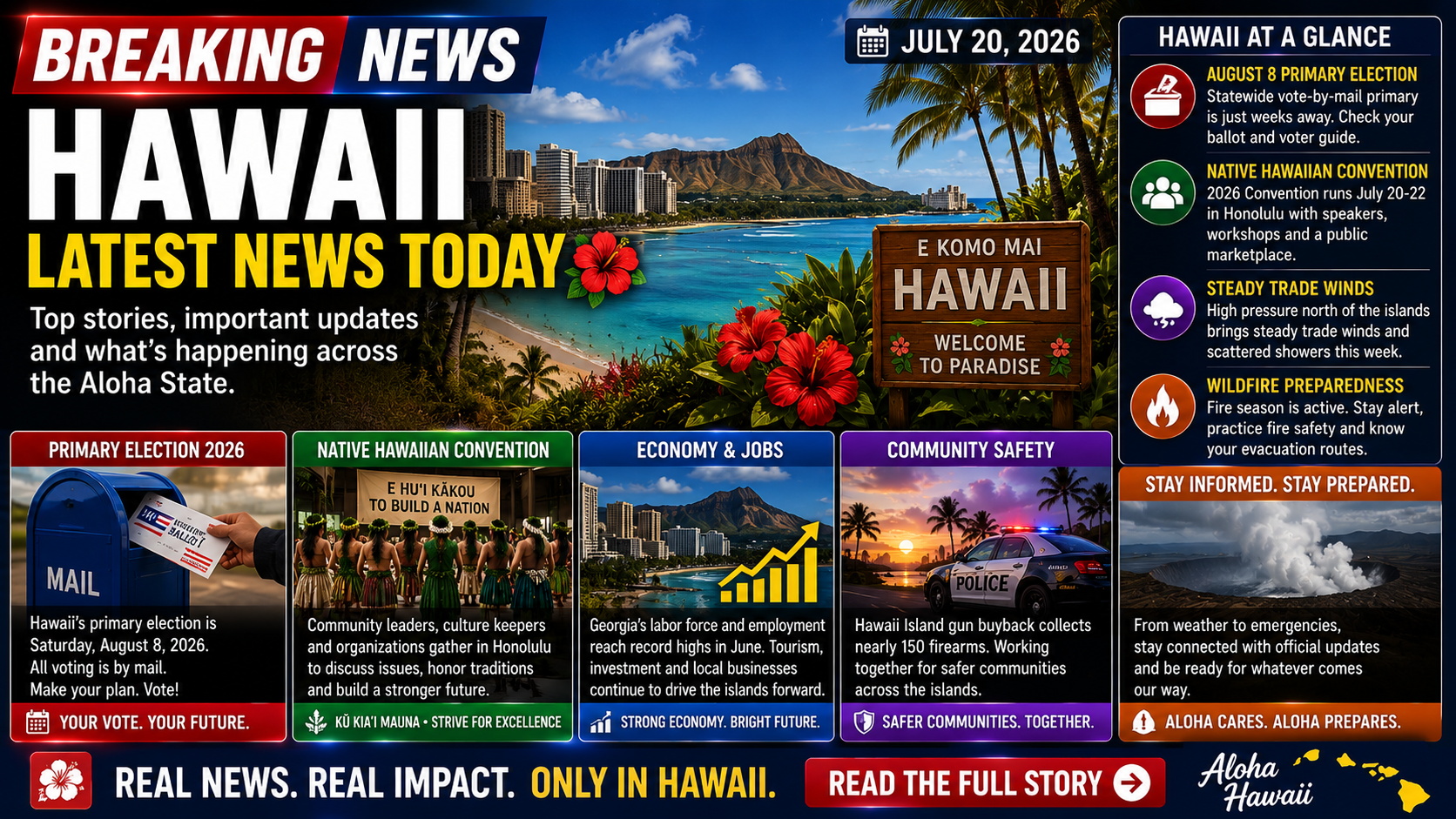
Hawaii is entering a busy period of political, cultural, economic, and community activity as the state prepares for its 2026 primary election, the Native Hawaiian Convention opens in Honolulu, and residents continue to monitor summer weather and wildfire risks across the islands.
One of the most important upcoming events is Hawaii’s statewide primary election, scheduled for Saturday, August 8. Election officials are preparing voters for the vote-by-mail process as candidates compete for federal, state, and county offices.
At the same time, Honolulu is welcoming the 2026 Native Hawaiian Convention, which runs from July 20 through July 22. The gathering brings together community leaders, organizations, cultural practitioners, businesses, and residents to discuss issues affecting Native Hawaiians and the future of the islands.
Meanwhile, Hawaii is experiencing generally steady trade-wind weather, while state emergency officials continue to emphasize wildfire preparedness during the summer fire season.
Together, these developments highlight an important moment for Hawaii as residents focus on elections, cultural issues, economic challenges, and community safety.
Hawaii Prepares for August Primary Election
Political attention across Hawaii is increasingly turning toward the state’s 2026 primary election.
According to the Hawaii Office of Elections, the primary is scheduled for Saturday, August 8, 2026. The election will be conducted by mail, continuing Hawaii’s statewide vote-by-mail system.
The primary will determine which candidates advance to the November 3 general election in several important contests.
For voters, the weeks leading up to the primary are an important time to review candidate information, understand voting procedures, and make sure registration details are current.
Hawaii’s elections cover a wide range of offices that directly affect residents, from federal representation to state and county government.
Election officials have released voter guides to help residents understand the process.
As the primary approaches, political campaigning is expected to become increasingly visible across the islands.
Native Hawaiian Convention Opens in Honolulu
Another major event beginning Monday is the 2026 Native Hawaiian Convention.
The convention is being held in Honolulu from July 20 through July 22 and includes speakers, workshops, discussions, and a public marketplace.
The gathering provides an important platform for conversations about Native Hawaiian communities, culture, education, economic development, housing, health, and other issues.
Events such as the Native Hawaiian Convention also create opportunities for community organizations and leaders to discuss long-term priorities and strengthen connections between residents from different islands.
Hawaii’s unique cultural identity is deeply connected to Native Hawaiian history and traditions.
For many participants, the convention represents an opportunity to celebrate that heritage while addressing modern challenges facing Native Hawaiian families and communities.
Trade Winds Shape Hawaii’s Weather
Weather conditions are also an important part of today’s news across Hawaii.
Forecasts for Monday indicate that steady trade winds will be a major feature of the week’s weather because of a high-pressure system positioned north of the islands.
Trade winds are a familiar part of Hawaii’s climate and can provide some relief from summer heat.
Depending on atmospheric conditions, trade winds can also bring passing showers to windward and mountain areas while leaving many leeward locations relatively dry.
Residents and visitors should continue monitoring local forecasts, particularly when planning outdoor activities, hiking, boating, or spending time near the ocean.
Surf and marine conditions can vary significantly between islands and coastlines, making current forecasts especially important for people participating in ocean activities.
Wildfire Preparedness Remains Important
Although today’s weather is generally characterized by trade winds, wildfire risk remains an important concern during Hawaii’s summer months.
Earlier this month, the Hawaii Emergency Management Agency reminded residents that wildfire season was in full swing and encouraged the public to practice fire safety.
Hawaii has become increasingly focused on wildfire preparedness following devastating fires in recent years.
Dry vegetation, strong winds, and difficult terrain can create conditions that allow fires to spread rapidly.
Communities across the islands have been working to improve emergency planning, evacuation procedures, vegetation management, and public awareness.
State and local officials continue to encourage residents to understand evacuation routes and prepare emergency supplies before a disaster occurs.
Wildfire preparedness is particularly important because changing wind conditions can cause a fire to move quickly, leaving residents with limited time to evacuate.
Hawaii Island Gun Buyback Collects Nearly 150 Firearms
Public safety is also receiving attention on Hawaii Island.
According to Big Island Now, residents recently turned in nearly 150 firearms during a community gun buyback event.
The initiative was intended to provide residents with an opportunity to voluntarily surrender unwanted firearms.
Hawaii Island Police Chief Reed Mahuna connected the event to broader concerns about the dangers of firearms falling into the wrong hands.
Community gun buybacks are often designed to reduce the number of unwanted or unsecured firearms in circulation.
While researchers continue to debate the broader effects of individual gun buyback programs on crime rates, organizers often emphasize their role as one part of larger community-safety efforts.
The event represents one of several public-safety developments receiving attention across Hawaii this week.
State Government Completes Major Bill-Signing Period
Hawaii’s state government has also recently completed an important legislative milestone.
Governor Josh Green concluded the 2026 bill-signing period, with 266 of 267 measures from the legislative session becoming law, according to the governor’s office.
The governor signed three measures that had previously appeared on his intent-to-veto list and vetoed one measure.
The completion of the bill-signing period means state agencies and residents will now begin seeing the implementation of new laws approved during the 2026 legislative session.
The measures cover a broad range of policy areas affecting Hawaii.
The legislative process is particularly important in a state facing significant challenges involving housing affordability, the cost of living, health care, infrastructure, environmental protection, and disaster preparedness.
Hawaii’s Economy Faces Continuing Pressure
Economic conditions remain another important issue for Hawaii residents.
The state’s economy depends heavily on tourism and is particularly sensitive to changes in transportation and energy costs.
Earlier economic analysis from the University of Hawaii Economic Research Organization warned that international conflict and higher oil prices could increase inflation and travel costs while creating additional challenges for Hawaii’s economy.
Because Hawaii imports many goods from outside the islands, increases in shipping and fuel costs can affect household expenses.
Higher airline costs could also influence tourism, one of the state’s most important industries.
For residents, these pressures come on top of long-standing concerns about housing affordability and the overall cost of living.
Why Today’s Hawaii News Matters
The latest developments demonstrate the wide range of issues shaping life across Hawaii.
The August primary election will give residents an opportunity to influence the state’s political direction.
The Native Hawaiian Convention provides a major forum for cultural and community discussions.
Wildfire preparedness remains an essential public-safety priority.
Meanwhile, state leaders continue implementing legislation intended to address Hawaii’s economic and social challenges.
These issues are interconnected.
Political decisions affect housing, infrastructure, environmental protection, disaster response, and economic development, while cultural and community organizations play an important role in shaping Hawaii’s future.
What Happens Next?
In the coming weeks, attention will increasingly focus on Hawaii’s August 8 primary election.
Voters should follow official election information as ballots are distributed and voting deadlines approach.
The Native Hawaiian Convention will continue through July 22, bringing together participants for discussions and events in Honolulu.
Residents should also continue monitoring local weather and wildfire conditions throughout the summer.
As of July 20, 2026, Hawaii’s latest news reflects a state balancing immediate community concerns with important decisions about its long-term future.
From the approaching primary election and the Native Hawaiian Convention to wildfire preparedness, public safety, and economic pressures, the coming weeks will be an important period for communities throughout the Hawaiian Islands.