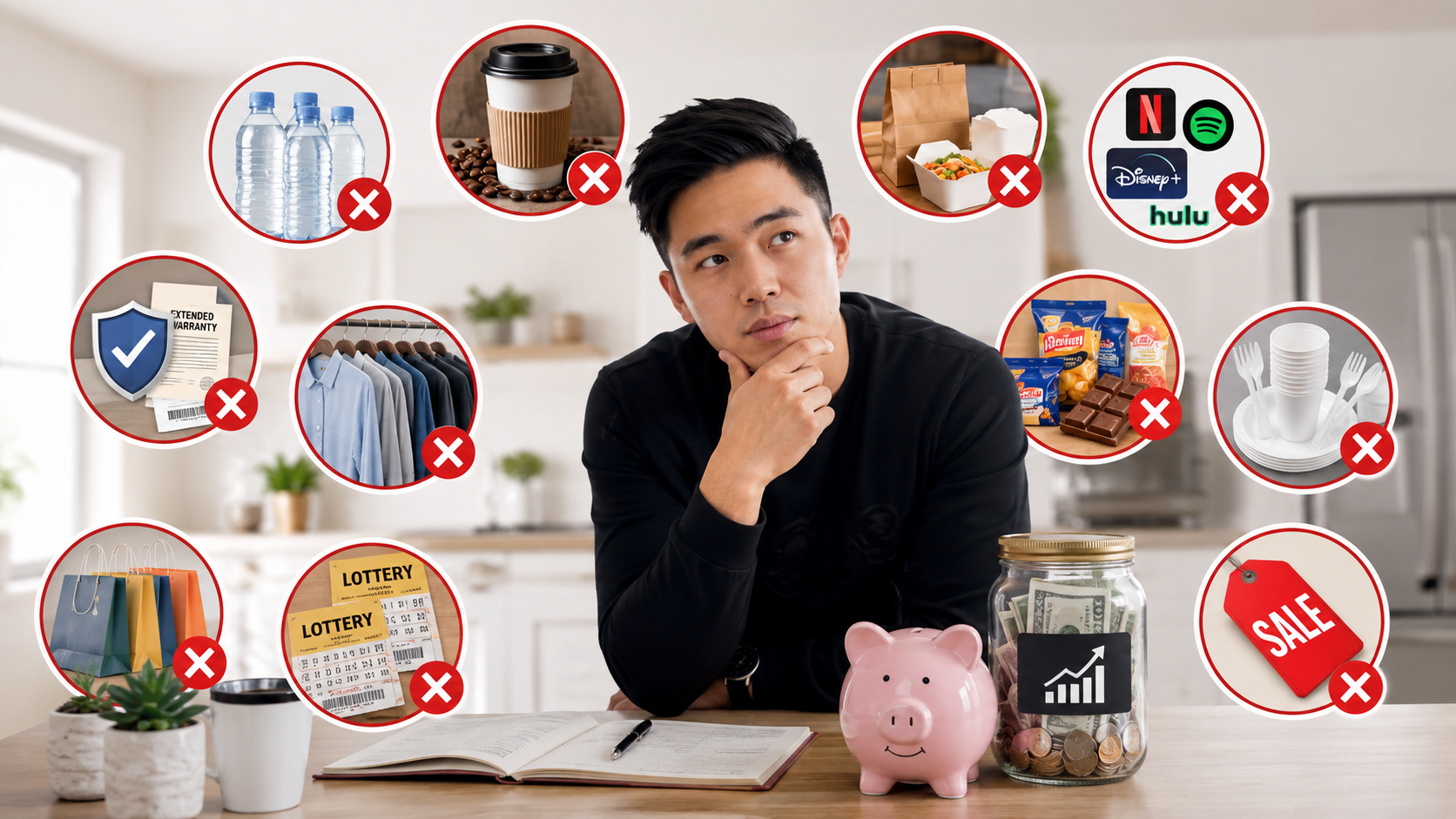
12 Things You Should Stop Buying to Save More Money
Saving money does not always require earning a bigger salary or completely changing your lifestyle. Sometimes the easiest place to start is by looking at the small purchases you make repeatedly.
A $5 purchase may seem insignificant, but if you make it several times each week, the annual cost can reach hundreds or even thousands of dollars.
The goal isn’t to stop enjoying life. It’s to identify purchases that provide little lasting value and redirect that money toward things that matter more—such as an emergency fund, paying down debt, investing, traveling, or preparing for retirement.
Here are 12 things you may want to stop—or at least reduce—buying if you want to save more money.
1. Bottled Water
Buying individual bottles of water regularly can become surprisingly expensive.
If the tap water where you live is safe to drink, using a reusable bottle can be much cheaper. A home water filter may also be worthwhile if you prefer filtered water.
Imagine spending just $2 on bottled water five times per week. That’s roughly $520 per year.
You don’t necessarily need to eliminate bottled water completely. It can still be useful while traveling or when safe drinking water isn’t readily available.
Money-saving alternative: Carry a reusable water bottle.
2. Daily Coffee Shop Drinks


Coffee itself isn’t necessarily the problem—the frequency can be.
Suppose your usual coffee shop order costs $6 and you purchase it five times per week. That works out to approximately $1,560 over 52 weeks.
Preparing coffee at home most mornings and treating yourself occasionally can preserve the experience while dramatically reducing the expense.
Money-saving alternative: Make your everyday coffee at home and reserve café visits for occasional treats.
3. Food Delivery
Food delivery is convenient, particularly after a long day.
But the final bill can include menu markups, delivery charges, service fees, taxes, and tips. A meal that appears reasonably priced can become considerably more expensive at checkout.
If you still want restaurant food, picking up the order yourself may reduce some costs.
Better yet, keep several quick meals at home for nights when you don’t want to cook.
Money-saving alternative: Meal prep, keep easy freezer meals available, or pick up restaurant orders yourself.
4. Unused Subscriptions
Streaming platforms, music services, cloud storage, fitness apps, premium apps, gaming subscriptions, and other recurring services can quietly drain your bank account.
A $10 monthly subscription doesn’t seem significant.
But five unnecessary $10 subscriptions equal $600 per year.
Review your bank and credit-card statements and identify services you haven’t used recently.
Money-saving alternative: Keep the subscriptions you actually use and cancel the forgotten ones.
5. Extended Warranties You Don’t Need
Extended warranties are frequently offered when purchasing electronics, appliances, and other products.
They can be worthwhile in certain situations, but purchasing one automatically isn’t always the best financial decision.
Before paying, check the manufacturer’s warranty and whether your credit card provides additional purchase protection. Also compare the warranty price with the cost of replacing or repairing the product.
Money-saving alternative: Evaluate warranties individually rather than automatically saying yes.
6. Trendy Clothes You Rarely Wear
Fast-changing fashion trends can encourage people to buy clothes they wear only once or twice.
Instead, consider building a wardrobe around versatile items that work with multiple outfits.
Before buying something, ask yourself:
“Would I realistically wear this at least 20 or 30 times?”
If not, the low sale price may not represent good value.
Money-saving alternative: Buy fewer, more versatile pieces and consider secondhand shopping.
7. Brand-Name Products When Generic Works


Brand loyalty can become expensive.
For many grocery and household products, store-brand alternatives may provide similar functionality for less money.
Compare ingredients, quantities, nutrition labels, and unit prices rather than assuming the most recognizable brand is automatically better.
This doesn’t mean every generic product will be identical. Keep paying for the brands where you genuinely notice a worthwhile difference.
Money-saving alternative: Test the store-brand version once and compare.
8. Pre-Cut Fruits and Vegetables
Convenience often comes at a premium.
Pre-cut fruit, chopped vegetables, individually packaged snacks, and other prepared foods can cost considerably more than buying the whole product and preparing it yourself.
When you have the time, chopping several days’ worth of vegetables at once can provide much of the convenience without repeatedly paying the preparation premium.
Money-saving alternative: Buy whole produce and prepare several portions at home.
9. Disposable Household Products
Paper plates, disposable cups, plastic utensils, cleaning wipes, and similar single-use products can become recurring household expenses.
Reusable plates, cups, cloths, food containers, and other washable products can reduce repeated purchases when practical.
There are situations where disposable products are useful, but they don’t necessarily need to be the everyday default.
Money-saving alternative: Use washable products for routine household needs.
10. Impulse Purchases
One of the most effective ways to save money is simply to create more time between wanting something and buying it.
Online shopping makes impulse spending incredibly easy. You see something, tap a button, and the purchase is completed within seconds.
Try a 24- or 48-hour rule for nonessential purchases.
Add the item to your cart or wish list, then wait.
You may discover that the desire disappears once the initial excitement is gone.
Money-saving alternative: Create a waiting period before nonessential purchases.
11. Lottery Tickets
Buying an occasional lottery ticket for entertainment is one thing. Treating lottery tickets as a financial strategy is something completely different.
Lottery games are designed so that the average amount returned to players is lower than the amount wagered.
Suppose someone spends $20 every week on tickets. That’s approximately:
$20 × 52 = $1,040 per year.
Redirecting even part of that money toward savings creates an asset you actually own.
Money-saving alternative: Automatically transfer the same amount into savings.
12. Things You Buy Just Because They’re on Sale
A discount doesn’t automatically make something a bargain.
A $100 item reduced to $60 isn’t a $40 saving if you never needed the item in the first place.
You still spent $60.
Sales can be useful when they reduce the price of something you had already planned to purchase. Problems begin when the discount itself becomes the reason for buying.
Before purchasing, ask:
“Would I buy this if it weren’t on sale?”
If the answer is no, consider walking away.
Money-saving alternative: Shop from a list rather than from advertisements.
Small Purchases Can Become Big Numbers
Consider someone who changes only four habits:
They save $15 per week by making coffee at home, $25 per week by reducing food delivery, $30 per month by canceling subscriptions, and $50 per month by reducing impulse purchases.
Over one year, that’s approximately:
Coffee: $780
Food delivery: $1,300
Subscriptions: $360
Impulse purchases: $600
Potential annual savings: $3,040.
The actual amount will vary from person to person, but the principle is important.
You don’t always need one enormous financial change. Several smaller changes can produce meaningful results when repeated for an entire year.
Don’t Eliminate Everything You Enjoy
Saving money should not mean removing every enjoyable purchase from your life.
If buying coffee with a friend every Saturday makes you happy, you may decide that it is absolutely worth the money.
The objective is to eliminate low-value spending, not everything enjoyable.
Spend intentionally on the things you value and cut aggressively from the things you don’t.
The Bottom Line
You don’t have to stop buying all 12 things tomorrow.
Start with two or three categories that are costing you the most money. Calculate what you currently spend each month and decide how much you could realistically reduce.
Most importantly, don’t simply stop spending the money—redirect it.
If you save $100 by canceling subscriptions and reducing takeout, automatically transfer that $100 into your savings account.
That’s when cutting expenses turns into actual financial progress.
Spend less on what you don’t need so you have more money for what truly matters.