Wildfire Smoke Blankets Parts of the United States: A Major Event This Morning
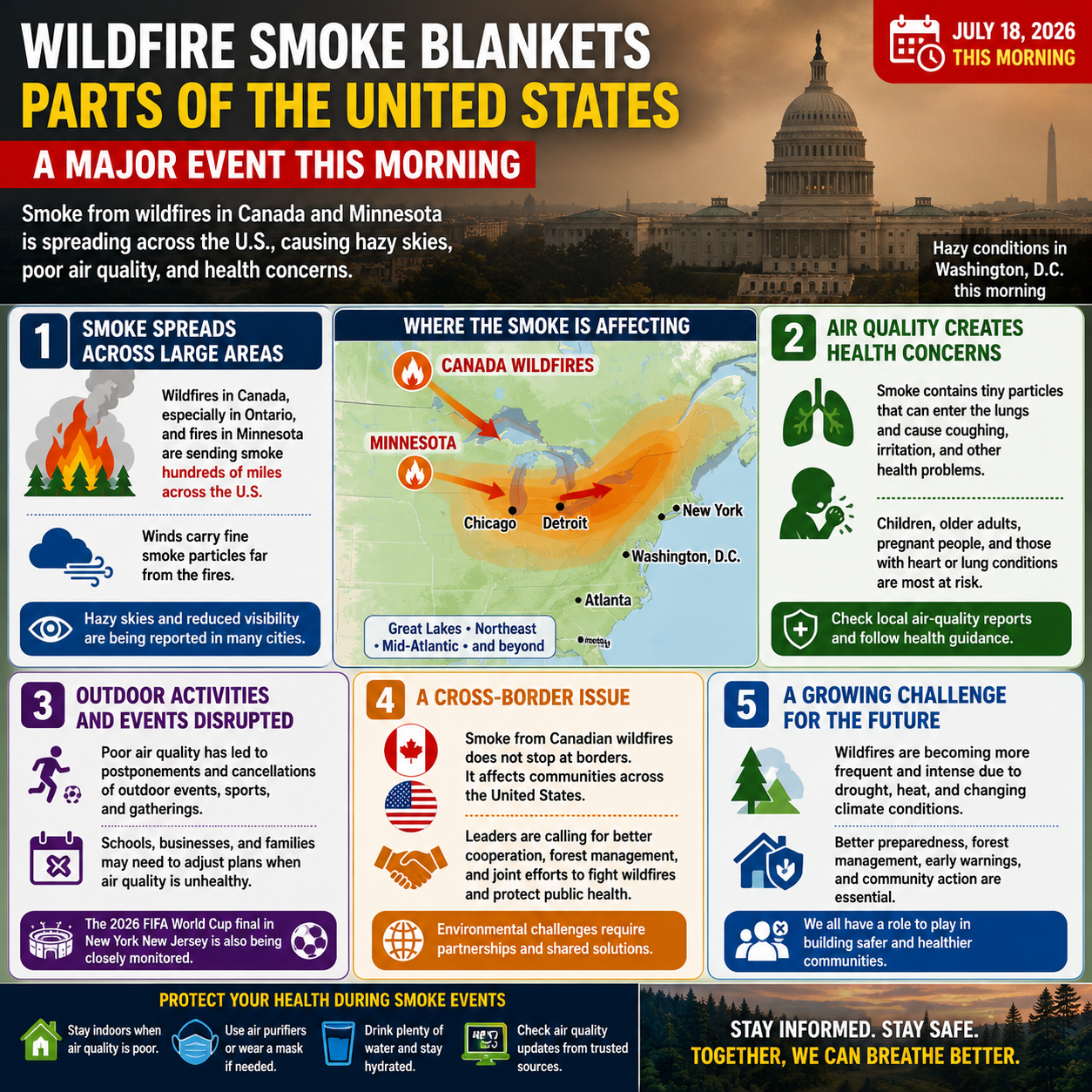
One of the most significant events affecting the United States this morning, July 18, 2026, is the widespread wildfire smoke that has spread across large areas of the country. Smoke from major wildfires burning in Canada, along with fires in parts of Minnesota, has traveled hundreds of miles and created hazy skies and poor air quality in several American cities and regions. The situation has raised concerns about public health, transportation, outdoor activities, and the growing impact of severe wildfire seasons across North America.
The smoke has affected parts of the Great Lakes region, the Northeast, and the Mid-Atlantic. Cities including Washington, D.C., Chicago, and Detroit have experienced hazy conditions, while residents in affected areas have been advised to pay attention to local air-quality warnings. The situation demonstrates how wildfires can have consequences far beyond the places where the fires are actually burning.
Here are five important aspects of this major environmental event affecting the United States.
1. Wildfire Smoke Spreads Across Large Areas
The most visible impact of the wildfires is the enormous amount of smoke traveling across the United States.
Many of the fires producing the smoke are burning in Canada, particularly in Ontario, while fires in Minnesota have also contributed to poor air conditions. Winds can carry fine smoke particles over very long distances, meaning communities hundreds or even thousands of miles away from an active wildfire may still experience its effects.
As the smoke moves south and east, it can create gray or orange skies and reduce visibility. Famous landmarks in Washington, D.C., have appeared under a layer of haze, demonstrating the enormous geographical reach of the smoke.
The event is a reminder that wildfires are not only local disasters. Even when flames do not directly threaten a city, smoke can travel across state and international borders.
The widespread nature of the current smoke event has made it an important issue for millions of people. Residents are monitoring air-quality reports to determine whether conditions are safe for outdoor activities.
2. Air Quality Creates Public Health Concerns
One of the greatest concerns associated with wildfire smoke is its effect on human health.
Wildfire smoke contains extremely small particles that can enter the respiratory system. When air pollution reaches unhealthy levels, exposure can cause symptoms such as coughing and irritation of the eyes, nose, and throat. Poor air quality can be particularly concerning for children, older adults, pregnant people, and individuals with existing heart or respiratory conditions.
Health authorities generally encourage people to monitor official air-quality information during major smoke events. When pollution levels become unhealthy, reducing prolonged or strenuous outdoor activity can help limit exposure.
The current situation has therefore become more than an environmental story. It is also an important public-health issue affecting communities across multiple states.
People who live far from the actual wildfires may sometimes underestimate the risks because they cannot see any nearby flames. However, smoke pollution can affect communities located a great distance from the original fire.
This is why accurate weather forecasts and air-quality monitoring are so important during wildfire events. They allow residents to understand changing conditions and make appropriate decisions about their daily activities.
3. Outdoor Events and Daily Activities Face Disruptions
The wildfire smoke has also affected normal activities in some communities.
Poor air quality can lead organizers to postpone or cancel outdoor sporting events and public gatherings. According to reports, the smoke has already contributed to disruptions involving outdoor events in affected areas.
Schools, sports organizations, businesses, and families may also need to adjust their plans when air quality becomes unhealthy. Children who normally play outside may need to spend more time indoors, while athletes and outdoor workers can face additional challenges.
Transportation may also be affected when smoke becomes extremely thick and visibility decreases, although the severity of these impacts depends on local conditions.
The timing of the smoke is particularly notable because the United States is hosting the final stages of the 2026 FIFA World Cup. The tournament’s championship match between Spain and Argentina is scheduled for Sunday at the New York New Jersey Stadium.
Although weather conditions can change quickly, the presence of wildfire smoke across parts of the region has added another issue for organizers and fans to monitor ahead of one of the world’s biggest sporting events.
The situation illustrates how environmental events can influence many different aspects of society, including sports, tourism, transportation, business, and everyday life.
4. Canadian Wildfires Have Become an International Issue
The wildfire situation also demonstrates the close environmental connection between Canada and the United States.
Air pollution does not stop at national borders. Smoke produced by fires in Canadian forests can travel south into the United States, just as environmental events in the United States can sometimes affect neighboring countries.
Canada contains some of the world’s largest forested areas, and wildfires are a natural part of many forest ecosystems. However, extremely large and intense wildfire seasons can produce enormous quantities of smoke.
Scientists have warned that climate change can contribute to conditions that increase wildfire risk in many regions. Higher temperatures can dry vegetation and create conditions in which fires may start more easily or spread more rapidly. However, the causes and behavior of individual wildfires can vary depending on weather, vegetation, lightning, human activity, and other factors.
The current smoke crisis has also attracted political attention. President Donald Trump has criticized Canada’s management of its forests and suggested that the costs associated with cross-border smoke should be considered in broader economic discussions between the two countries.
Regardless of political disagreements, the situation highlights the importance of international cooperation. The United States and Canada share a long border and many interconnected ecosystems. Wildfires, air pollution, rivers, weather systems, and other environmental issues often affect both countries.
Cooperation in firefighting, emergency response, scientific research, and air-quality monitoring can therefore be important for protecting communities on both sides of the border.
5. The Event Highlights the Growing Challenge of Wildfires
Perhaps the most important long-term lesson from the current situation is the growing challenge that wildfires represent for North America.
Large wildfire events have repeatedly affected communities across the United States and Canada in recent years. Even people living in major cities far from forests have experienced smoky skies and unhealthy air conditions.
Governments and communities may need to continue improving their preparations for future wildfire seasons. This can include better forest management where appropriate, improved firefighting resources, stronger emergency communication systems, and expanded air-quality monitoring.
Individuals can also become better prepared by understanding local air-quality information and following guidance from public-health authorities during smoke events.
At the same time, addressing the broader environmental factors that contribute to extreme wildfire conditions remains an important long-term challenge.
The current smoke event demonstrates that wildfire preparedness is not only important for communities located near forests. Cities hundreds of miles away can also experience serious consequences.
As populations grow and environmental conditions change, governments, scientists, firefighters, and communities will need to work together to reduce risks and protect public health.
Conclusion
In conclusion, one of the most significant events affecting the United States this morning is the widespread wildfire smoke moving across parts of the country from fires in Canada and Minnesota.
The event has created poor air quality, public-health concerns, disruptions to outdoor activities, cross-border political attention, and renewed discussion about the growing challenge of severe wildfires.
The situation is particularly significant because it demonstrates how an environmental disaster in one region can affect millions of people far away. A wildfire burning hundreds of miles from a major city can still influence the air that residents breathe and the activities they can safely enjoy.
For people in affected areas, monitoring official air-quality information and following local health guidance remain important as conditions change.
In the longer term, the event serves as another reminder that wildfire management and environmental cooperation are increasingly important issues for both the United States and Canada. Protecting forests, strengthening emergency preparedness, improving air-quality monitoring, and addressing the conditions that contribute to extreme fires will all be essential for reducing the impact of similar events in the future.